Your Microsoft Technology Development and Consulting Experts - Operating since 2000

Australia WideSydney, NSWMelbourne, VicBrisbane, QldPerth, WAAdelaide, SACanberra, ACTNorthern Rivers, NSWWollongong, NSWRichmond, VicDarwin, NT
Your Microsoft Technology Development and Consulting Experts - Operating since 2000


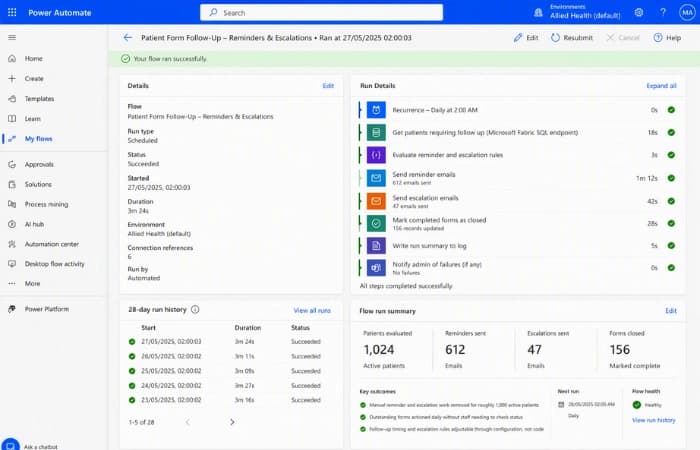
An allied health provider was sending intake and milestone forms to every patient but tracking who had and had not responded entirely by hand, pulling clinical staff away from care to send reminders and escalations. We built two scheduled Power Automate flows against the provider's Microsoft Fabric data warehouse that send reminders, escalate overdue cases and close off completed forms automatically.
The challenge
This allied health provider sent intake forms to every new patient and milestone forms at set points through their treatment, standard practice for the sector, and generally straightforward on its own. The problem was what happened after a form went out.
Tracking who had responded and who hadn't was done entirely by hand. Clinical and admin staff were checking spreadsheets and inboxes to work out which of roughly 1,000 active patients still owed a form, then manually sending reminders, and manually escalating anything that stayed outstanding too long.
This was time pulled directly away from patient care, spent on a task that was really just status checking and message sending. It also meant follow-up timing depended on whoever happened to be checking that day, rather than a consistent rule applied to every patient the same way.
The provider's data already lived in a Microsoft Fabric data warehouse, so the information needed to know who was overdue existed. It just wasn't being acted on automatically.
Our approach
We worked through the provider's existing (manual) process to define exactly when a reminder should be sent, when a case counted as overdue enough to escalate, and what closing off a completed form should look like. This became the rule set the automation would run against.
The first Power Automate flow runs on a schedule against the Microsoft Fabric data warehouse, checking outstanding forms across all active patients and sending reminders automatically to anyone who hasn't responded within the agreed window.
A second scheduled flow identifies forms that have gone past the reminder stage without a response and escalates them, flagging the case for staff attention rather than leaving it to be noticed manually. Completed forms are closed off automatically as part of the same process, so nobody is chasing a form that's already been returned.
Follow-up timing and escalation thresholds were built as configuration values rather than hardcoded logic, so the provider can adjust how soon a reminder goes out, or how long before a case escalates, without needing a developer involved for a simple timing change.
Before going live, we ran both flows against the provider's real Fabric data in a controlled way to confirm reminders, escalations, and closures were all firing correctly across genuinely overdue, borderline, and already-completed cases.
The outcome
Manual reminder and escalation work has been removed for the provider's roughly 1,000 active patients. Staff are no longer spending clinical time checking spreadsheets to work out who owes a form.
Outstanding forms are now actioned daily by the two scheduled flows, with reminders sent and overdue cases escalated automatically, without anyone needing to check status first.
Because follow-up timing and escalation rules were built as configuration, the provider can adjust how the process behaves as their patient load or clinical requirements change, without needing new development work for what is really just a timing adjustment.
“Our staff were spending real time every week just chasing paperwork status. That time is back with our patients now, and the forms still get chased, just automatically.”
Practice Manager, Allied Health Provider
Copyright © 2024. Brayalei Pty Ltd T/As Office Experts Group. ABN 32 093 067 737. ACN 093 067 737. All Rights Reserved.
 consult@officeexperts.com.au
 1300 102 810